
Brett’s Story: A Journey Back to Life


Brett Willis was born on March 27, 1966. A lifelong athlete with a background in athletics and bodybuilding, his body had always been his ally: strong, capable, and resilient. That changed in an instant on the afternoon of July 25, 2024.

Content Note: This post discusses severe injury, medical interventions, and psychological hardship, which some readers may find difficult.
The moment things changed
At approximately 4:15 p.m., Brett was riding his motorcycle home from work when a car made a sudden U-turn directly in front of him. Brett collided with the vehicle’s rear windscreen and was thrown to the side of the road. His motorcycle was completely written off.
What happened next was extraordinary.
People emerged from their homes. Motorists stopped. Strangers worked together instinctively and tirelessly to keep Brett alive until paramedics arrived. One first aider later told Brett’s wife, Billie, that she had never witnessed such mateship -- such collective care for another human being. Brett had lost a tremendous amount of blood, yet he remained conscious, repeatedly attempting to stand despite the severity of his injuries.
He should not have survived.
The Injuries
The trauma Brett sustained was catastrophic and extensive including:
- Brain hemorrhage with bleeding directly into functional brain tissue
- Ruptured right subclavian artery and torn internal jugular vein
- Right lung palsy and repeated fluid accumulation in the left lung
- Paralysis of the right arm and leg (the leg began minimal movement after 10 days)
- Severe facial, neck, and chin lacerations with embedded glass
- Deep vein thrombosis in both legs
- Five broken ribs, including fractures to both first ribs
- Post-ganglion pan-plexus injury affecting the entire right arm
- Open-book pelvic fracture
- Bladder, urethra, and prostate injuries with urine leaking into the left leg
- Rectus sheath hematoma
- Dislocated left thumb
- Torn ligaments in 3 fingers
Doctors were unsure if Brett would ever speak again. Movement on the right side of his body was absent. His prognosis was grim.
Fighting for Survival
Brett was rushed into emergency surgery. In the hours and days that followed, his body endured relentless intervention:
- Intubation and nasal feeding tube
- Four chest drains inserted into the left lung
- External ventricular drain placed in the skull to relieve pressure on the brain
- Emergency bladder surgery (with additional surgeries later required)
- Blood transfusions
- Suprapubic and urethral catheters
- Pelvic reconstruction with plates, screws, and staples
- Microsurgery to the lip, chin, neck, and fingers
- Debridement to remove glass from soft tissue
- Five central lines inserted into the neck for medication and antibiotics
Brett was placed in the Intensive Care Unit on July 25, 2024, where he would remain for weeks. He was intubated and on life support for a total of 22 days.
Billie was told a truth no partner should ever hear: The longer someone remains in ICU, the lower their chance of survival.
During the first six weeks, Brett experienced terrifying delusions and paranoia as sedation was reduced. Billie later shared:
“One of the worst things I have ever experienced was watching Brett come out of an induced coma, three separate times. The pain was excruciating. He was disoriented, didn’t recognize people, didn’t know where he was, and couldn’t communicate what he was feeling.”
Complications continued to arise. Fluid repeatedly reaccumulated in the left lung, requiring four additional chest tubes. An IVC filter was inserted to prevent blood clots from reaching his lungs. He developed hospital-acquired pneumonia and was placed on high-dose antibiotics, which led to severe gastrointestinal breakdown, dehydration, and malnourishment.
Learning to Live Again
Eventually, Brett was moved to the trauma ward.
The staple was removed from his pelvis, but emergency bladder surgery was again required due to internal bleeding. He had to relearn how to sit, stand, and walk, without the proper equipment to support someone with only one functioning arm. Every movement was painful, exhausting, and frustrating.
Carbon dioxide levels in his blood rose dangerously, requiring supplemental oxygen for two weeks and nightly CPAP use for over a year.
After nearly three months in hospital, Brett made the decision to discharge himself on October 16, 2024.
The challenges did not end there.
Over 75 medical appointments followed. He developed urinary tract infections. Statin medication caused severe muscle stiffness and progressive loss of function until it was discontinued.
His right arm remained paralyzed, hanging lifelessly at his side and causing unrelenting, overwhelming pain. The only medical options offered were fusion or amputation, neither of which guaranteed relief.
The pain became so intense that Brett admitted he no longer wanted to live.
A Different Path
Months later, Billie, who was enrolled in the Block Therapy Academy and has since become certified, reached out to me.
Brett and Billie live in Australia. For several months, we met regularly over Zoom. I guided Billie so she could support Brett’s body at home. Those calls became a lifeline.
Both Brett and Billie told me they were the highlight of their month, something to hold onto. In October, I said without hesitation: “If you can make it to Canada, I will work with him in person.”
They immediately said yes.
This was no small decision. The journey from Australia to Canada is demanding for a healthy person, let alone someone in Brett’s condition. Their trust was instant. I felt deeply that something greater was guiding this choice.
They arrived in Winnipeg on November 25th, 2025, and we began work the following day.
The In-Person Work
Brett had just endured two full days of travel. His pain was extreme. His body was collapsed forward, his neck compressed, his upper body inflamed. He held his right arm constantly with his left, bent at a 90-degree angle, his entire structure twisted to protect it.
Before we began, we documented his starting point on video.
Over four weeks, we completed 18 in-person sessions, each lasting two hours. This time was essential. It allowed not only targeted work, but full-body integration. Having said that, I was fortunate to have Billie assist me with the work as even though we had significant time together, the extent of his injuries was paramount and I wanted to give the arm and areas that primarily impacted his pain, as much attention as possible.
Billie was an extraordinary partner throughout, working consistently on Brett’s lower body while I focused more of my time on his upper body.
By the third day, the tissue in Brett’s arm began to soften. Prior to this it felt as though it had been shrink-wrapped: dehydrated, frozen and full of areas of vitiligo (those white patches that demonstrate a lack of blood). Blood flow began to return and the color changed. Vitality appeared where none had existed.
When I asked why he always supported the arm, Brett explained that doctors had warned him never to let it hang due to a 5.5 cm deformity between the socket and humeral head. In that moment, I asked him to gently let the arm hang: I mean, how much worse could it get? The only options they gave him were amputation or fusion, neither of which guaranteed relief. In that moment, something profound happened.
Without needing to support the arm, Brett regained a freedom, using his left arm that prior to this, was taken up with needing to support the right. He stood more upright, his balance improved and the protective twisting pattern began to release.
A week later, Brett shared that since the accident, he had not been upright for more than five minutes at a time, either sitting or standing. That day, he sat upright for over an hour as I worked his shoulder and arm. That same week, they attended my staff Christmas party. Brett stayed for two and a half hours, walking, engaging, participating fully.
The shift was undeniable.
During one session, Brett revealed he was diagnosed with Ischemic Optical Neuropathy in his right eye causing significant vision loss and pain with every eye movement. This was an issue long before his accident. He had been told that there was no recourse to correct this. One afternoon, sitting on my couch, he began identifying details around the room with clarity. His vision had much improved. He no longer needed eye drops or blue-light glasses during therapy sessions, something he usually requires every waking moment.
For many of the sessions, we worked deeply in his abdomen, where repeated surgeries had caused the bladder to fuse to the abdominal wall. As this released, his breathing changed and incontinence improved. Also, as we freed the diaphragm, movement visibly returned to the right side that had been paralyzed. His ribcage, once rigid from lung collapse, began to lift and respond with elasticity.
Even cognitively, change emerged. Damage to the left hemisphere had left Brett emotionally overwhelmed and mentally foggy. Over time, clarity returned. He shared that while communicating with his kids over zoom, that one of them mentioned they noticed much improvement in his speech and overall communication.
The Breaking Point—and the Breakthrough
During one of the final sessions, I worked deeply into his shoulder again, with consent and constant check-ins. The integration afterward was intense. I was supposed to see Brett the next day, but a blizzard forced a two-day break. Brett struggled from the pain as when blood flow moves into spaces previously blocked, pain can be intense, especially for something of this nature. Brett struggled deeply and momentarily lost hope.
When we reunited, he shared that he wanted to end his life.
I listened. I reminded him this was a moment in time, and that I would not allow him to give up. The next day, his pain had subtly diminished and for the first time since the injury, he could see blood vessels in his hand, a major sign of life moving in.
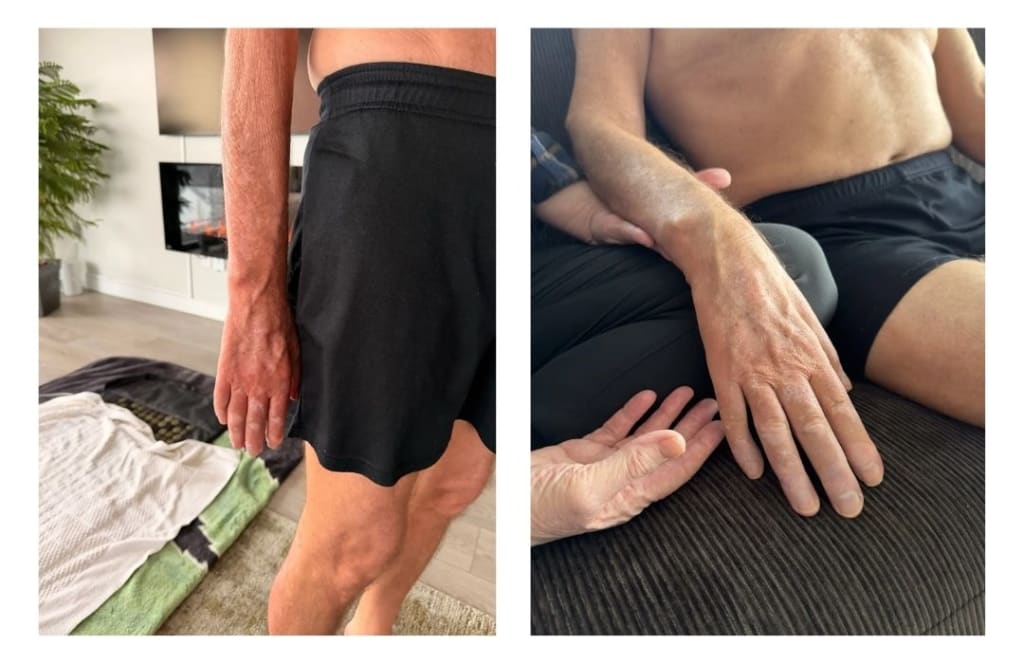
When he arrived on Monday, he was back with excitement and a willingness to continue. As the injury impacting his arm was rooted from his neck, I worked extensively in this area, where the pan-plexus injury had severed nerve roots.
Suddenly, Brett said: “The pain is gone.”
He had lived at a constant 6–8 out of 10. To find a pain-free space, even briefly, was extraordinary. While I worked in this area, the pain shifted from a 0 to a 10, and everything in between. I felt we had uncovered the main cause site to his arm pain and paralysis which would need lots of attention, but hopeful that with continued work from Billie, these moments of relief would grow.
When the session ended, he stood with an ease neither Billie nor I had ever seen since that fateful day back in July of 2024.
Then Brett began to dance.
We laughed. We cried. We filmed it.
It is a moment I will carry forever.
Moving Forward
They left the next night for the long journey home, facing delays, exhaustion, and uncertainty. Brett managed it all with resilience.
Days later, I received a video of him walking on a treadmill. Smiling. Hopeful.
Another message followed: he had walked 1.5 kilometers with less pain, better alignment.
Since they arrived home, there have been setbacks such as breathing challenges at times, incontinence, and of course, pain . . . but healing is never linear, and this journey is far from over.
With awareness, tools, Billie’s deepened skill, and my unwavering belief that we were brought together for a reason, this is only the beginning.
During one of our hardest days here in Winnipeg, Brett told me he didn’t feel deserving of joy, believing he had no purpose after months of dependence.
I told him: “Your purpose right now is to heal.”
What comes next remains to be seen, but I already see a man walking forward.A man reclaiming strength, intention, and hope. A man becoming a beacon of light: for me, and for so many others who have forgotten what is possible.
Stay tuned for more to come.
Breathe & Believe,
Deanna
Looking to take your Block Therapy practice to a new level?
The path of healing is ongoing, and so is the journey of growth as a practitioner. Registration for the next Block Therapy Bodyworker Certification opens on March 3.
If you’re a licensed bodyworker and feel called to explore these fascia-focused techniques in a structured, thoughtful way - the same approach that guided Brett’s journey - you can join the waitlist here. This is an opportunity to deepen your work, learn new ways to guide clients, and support positive, ongoing progress.
Follow us on our social channels below to learn more about Block Therapy and see some amazing transformations!


